Mickey Costume Font: Warm, Playful & Perfect for Handmade Goods
As a small shop owner who designs printable invitations, boutique labels, and SVG-based craft kits, I’ve tested dozens of script fonts—many too delicate, some too fussy, others just unreadable at small sizes. Then I found Mickey Costume. It’s not just another playful typeface—it’s a reliable, warm, and commercially smart choice for makers who need charm *and* clarity.
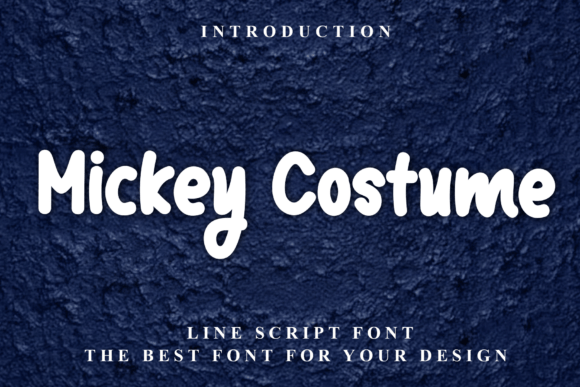
Mickey Costume is a casual script font from the Script Amp collection, designed with soft, rounded strokes that feel hand-drawn but never sloppy. There’s no sharp tension or exaggerated flair—just gentle curves, consistent spacing, and a relaxed rhythm that reads instantly as friendly and sincere. That warmth isn’t accidental. It translates directly to how customers perceive your products: a candle label in Mickey Costume feels artisanal and inviting; a baby shower invitation feels personal, not generic; a farmhouse-style wall sign feels grounded and joyful—not trendy and fleeting.
I use Mickey Costume across nearly every physical product I make. On 1.5-inch sticker sheets? Yes—it holds up beautifully down to 10 pt when printed on matte vinyl. For kraft paper gift tags? Its open letterforms prevent ink bleed and stay legible even with light pressure from my Cricut Explore Air 2. On cotton tote bags heat-pressed with iron-on vinyl? The rounded terminals and generous x-height ensure clean cuts and crisp edges every time. And for wedding welcome boards or seasonal market signage? It scales effortlessly from 24 pt on a 5×7 printable to 180 pt on a 24×36 foam board—no distortion, no thinning, no awkward gaps.
Where it shines most is in projects where emotional resonance matters as much as function. Think: handwritten-style bakery labels for sourdough loaves, “Hand-Poured” tags for soy candles, “Made With Love” headers on recipe cards, or “Little One” on newborn milestone prints. Mickey Costume doesn’t shout—it smiles. That subtle difference builds trust. Customers don’t just see text; they feel care.
Readability is where many script fonts fail—but Mickey Costume was built for real-world use. Its lowercase a, e, and o are fully closed and distinct. The g and y have clear descenders that avoid merging on small stickers or narrow jar labels. I’ve tested it at 8 pt on 3/4-inch round labels (for mini bath bomb packaging), and it remains legible under natural light and phone-flash photography—critical for Etsy mockups and social media posts.
For digital printables and templates, Mickey Costume adds instant personality without sacrificing structure. Planner covers, habit trackers, and printable wall art all benefit from its approachable flow. Unlike overly ornate scripts, it doesn’t compete with illustrations or watercolor backgrounds—it complements them. Pair it with a clean sans serif like Montserrat or Poppins for body text, and you get balance: warmth in the headline, clarity in the details. Or layer it over a soft serif like Cormorant Garamond for vintage-inspired stationery—Mickey Costume’s relaxed energy keeps the pairing feeling fresh, not dated.
It’s ideal for short, high-impact phrases: names on birth announcements, titles on greeting cards, shop names on storefront signs, slogans on tea towels. It’s not meant for long paragraphs—that’s not its job. But as a display font or accent typeface? It delivers consistently. I avoid using it for full-page menus or multi-paragraph product descriptions, but I reach for it first when naming a new collection, labeling a limited-edition soap bar, or designing a holiday mug wrap.
The Mickey Costume font family includes OTF and TTF files, plus basic OpenType features like standard ligatures and stylistic alternates—enough to add subtle variation without overcomplicating production. No swashes or excessive flourishes, which means fewer cutting errors in Silhouette Studio and smoother kerning in Canva or Affinity Designer. It supports English, Spanish, French, German, and Portuguese characters—essential if you sell internationally or design bilingual baby announcements.
Licensing is straightforward and maker-friendly: the commercial license covers physical products (stickers, mugs, apparel), digital downloads (PDF templates, SVG bundles), client work (like custom wedding suites), and even resale in editable design assets—as long as you’re not redistributing the font file itself. That peace of mind matters when you’re scaling from craft fairs to wholesale accounts.
In practice, here’s what works:
- Candle & soap labels: Use Mickey Costume for scent names (“Vanilla + Cedar”) and “Hand-Poured in Portland” footers—pairs perfectly with a thin sans serif for net weight and ingredients.
- Wedding stationery: Apply it to “Mr. & Mrs.” on ceremony programs and “Welcome” on acrylic table numbers—soft enough for rustic venues, polished enough for ballrooms.
- Farmhouse signs: Cut it from baltic birch plywood for “Gather Here” or “Eat Slowly”—its even stroke weight prevents charring on laser-cut edges.
- Holiday packaging: Print it on kraft mailer boxes for “Season’s Greetings from [Your Shop]”—feels handmade, not mass-produced.
- Digital printables: Use it for title pages in planner bundles or “You’ve Got This” affirmations—converts cleanly to PNG for Canva users.
What makes Mickey Costume different isn’t just how it looks—it’s how it *performs*. It cuts cleanly, prints clearly, scales reliably, and connects emotionally—all while fitting seamlessly into your existing toolkit alongside other Fonts like modern serifs or minimalist sans serifs. It’s the kind of premium font that earns repeat use because it solves problems, not creates them.
If your brand voice leans toward heartfelt, humble, and human—not flashy or corporate—Mickey Costume won’t just look right. It’ll feel like part of your process. Like choosing the perfect linen tag, the right soy wax blend, or the exact shade of sage green for your next batch: thoughtful, intentional, and quietly confident.